
Top Signs You Need Roofing Service – Don’t Ignore These
Here’s the short answer: curled or lifted shingle tabs, granules piling up in your gutters, cracked flashing, damp attic insulation, and soft fascia boards all mean your roof needs a professional inspection sooner rather than later. If any two of those show up together, schedule a repair within 30 days. If you’d rather not climb a ladder to check, call (361) 607-0835 and we’ll do it for you, free.
Most Los Angeles homeowners wait for a ceiling stain before they think about roofing service. That’s the trap. It’s also the most expensive way to find out you have a problem. Brennan Roofing home, says it plainly: “By the time water shows up inside the house, it’s been working its way through the roof for a year or more.”
The Signs Most Los Angeles Homeowners Miss
The earliest signs of a failing roof in Los Angeles rarely appear inside your living room. They’re outside, on the roof itself, or in the gutter. And almost nobody checks for them. Here’s what we look for on every Roof Inspection in Los Angeles we do, and what you can spot from the ground or a safe ladder without ever stepping onto the shingles.
1. Granule Loss in the Gutters
If your gutters have a layer of black or gray grit at the bottom, that’s not dirt. Those are the ceramic granules that protect your shingles from UV radiation. Every asphalt roof sheds some granules as it ages, but significant accumulation means the shingles are losing their outer layer and beginning to cook in direct sun. Los Angeles gets roughly 284 days of sun per year, and UV intensity here accelerates that breakdown faster than in most other cities. This is the single most reliable early indicator we see, and almost no homeowner knows to check for it until we point it out.
2. Lifted or Curled Shingle Tabs
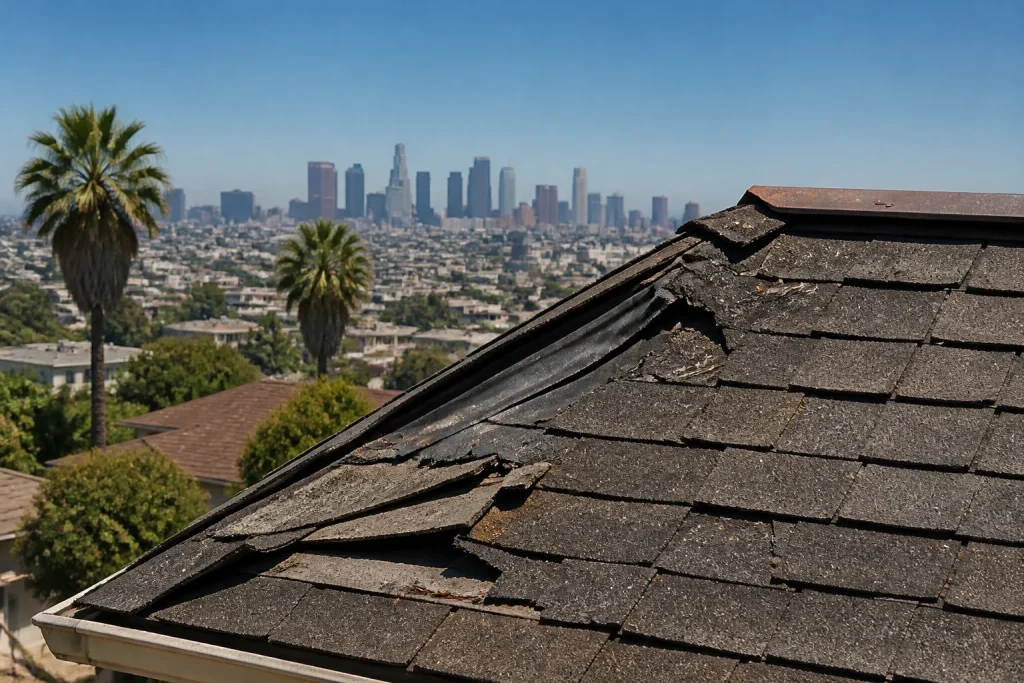
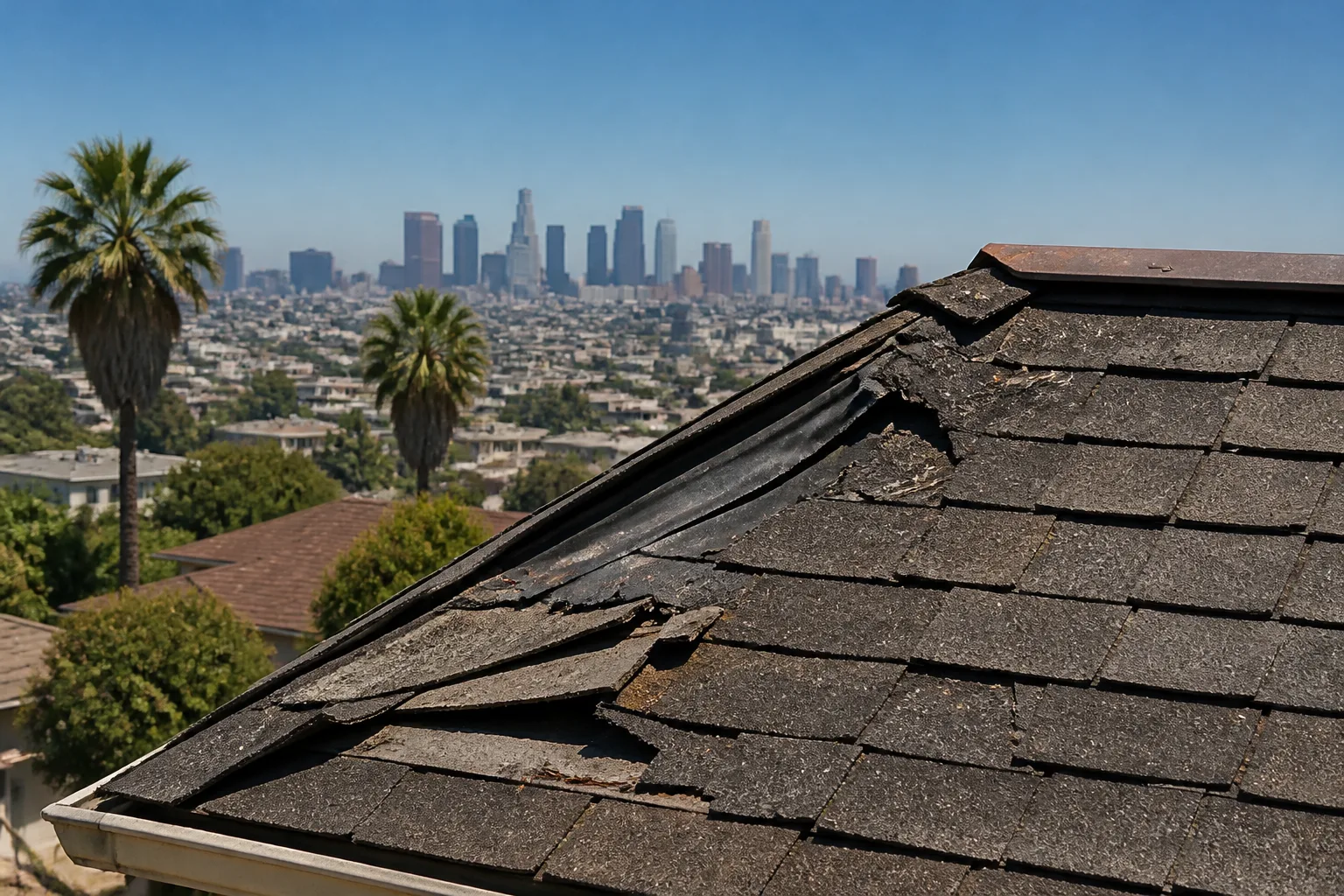
Stand across the street and look at the roof plane. Do any shingle corners appear raised, curled, or no longer laying flat? That’s a sealant failure. Shingle tabs are glued down to the shingle below them when the roof is installed. When that glue breaks down, the tabs lift. Wind gets underneath, water follows, and the roof’s first line of defense is gone. In the San Fernando Valley and the foothills, Santa Ana wind cycles make lifted tabs worse. A tab that’s lifted a quarter inch becomes a tab that’s torn off entirely by the next strong gust.
3. Flashing Gaps and Cracks
Flashing is the metal material that seals the places where the roof meets something else: chimneys, skylights, vent pipes, walls. It’s real trade word for the stuff that keeps water from sneaking into the seams of your roof. In Los Angeles, the daily expansion and contraction from hot afternoons and cool nights slowly separates the sealant around flashing. Look for gaps, rust, or cracked caulk around anything that pokes through the roof. A flashing gap is usually a $400 to $750 repair if caught early. Leave it for 18 months and you’re looking at replacing plywood decking, insulation, and possibly drywall inside the house. We’ve pulled one out of a garage over in Mar Vista where a two-inch flashing gap had quietly rotted the garage ceiling for a year and a half before the homeowner noticed the stain spreading across their stored boxes.
Cosmetic Aging vs. Structural Aging: What Actually Matters
Not everything that looks old is an emergency. Surface oxidation and minor discoloration are cosmetic. They mean your roof is aging, but they don’t mean it’s failing. Structural aging is different. Here’s how to tell them apart without getting on the roof.
- Cosmetic: Uniform color fading across the whole roof, slight surface roughness, minor staining. This is what a 12-year-old asphalt roof naturally looks like in the Los Angeles sun. It needs monitoring, not immediate repair.
- Structural: Lifted tabs, cracked field tile, exposed nail heads, missing shingles, failed sealant around flashing, soft spots in the decking. These are failures. They need professional attention.
We see this distinction matter a lot. A homeowner sees one lifted shingle and spends a weekend sealing it with a caulk gun, then ignores the cracked flashing behind the chimney because it’s harder to reach. The new caulk did nothing for the flashing, and a year later the ceiling is stained. Structural signs don’t go away on their own. They compound.
Why Los Angeles Roofs Age Differently
Your roof in Los Angeles is not like a roof in Seattle or Chicago. The stressors here are unique, and they’re brutal. Understanding them helps you interpret the signs correctly.
- Santa Ana winds: The hot, dry gusts that blow from the high desert through the mountain passes regularly hit 40 to 60 mph in the foothills and canyons. They don’t just blow debris onto your roof; they work lifted shingles back and forth like a loose tooth until they tear free. Homes in Altadena, La Cañada, and the northern Valley take the worst of it.
- UV intensity: Asphalt shingles are designed to resist UV radiation, but nothing resists it forever. Los Angeles averages more than 3,600 hours of sunshine per year. That’s why an asphalt roof here can look 15 years old after eight years. The granules wear down, and the asphalt underneath becomes brittle and prone to cracking.
- Hillside debris accumulation: Oak leaves, eucalyptus bark, pine needles, and chaparral litter collect in roof valleys and behind chimney crickets on hillside properties. They hold moisture, which means the roof decking underneath stays damp for weeks after a rain. Debris also clogs drains and scuppers, which are common on flat and low-slope roofs across the hills and coastal mesas.
- Marine layer moisture: Homes in Santa Monica, Pacific Palisades, Playa del Rey, and the Palos Verdes peninsula get bathed in cool, damp air every night. It settles on roofs, condenses around flashing, and slowly works into any gap or crack. Coastal properties don’t face the intense UV of the inland valleys, but they face persistent moisture, which breaks down sealant and rusts metal over time.
We also need to mention fascia moisture. Fascia boards are the wooden boards running along the roof’s edge where the gutters attach. When the roof doesn’t have proper drip edge, or when the drip edge corrodes, water wicks into the fascia. You can spot it from the ground: paint peeling from the board, dark staining, or a soft spot you notice when cleaning the gutters. Soft fascia is a structural sign, not a cosmetic one, and it’s always tied to a roof edge issue.
What a Simple Attic Check Can Tell You
You don’t have to get on the roof at all to catch some of the earliest signs. Your attic will tell you plenty if you know what to look for. On a dry, sunny day, go up with a flashlight and check for three things.
- Damp insulation: Insulation should be dry and fluffy. If it feels matted, damp, or smells musty, water is getting in somewhere above it. This is the first interior sign of a roofing problem, and it appears long before the ceiling stains.
- Stained decking: Look at the underside of the plywood decking, the wood the shingles are nailed to. Dark streaks, water rings, or white mineral deposits mean moisture has penetrated the roof. By the time you see this, the leak is active or recent.
- Light coming through: Turn off the flashlight and let your eyes adjust. If you can see daylight through any gap in the decking, water can get through that same gap. This is a direct, visual confirmation that your roof needs service, and it’s one of the fastest checks we teach homeowners.
Attic humidity in Los Angeles is also a factor that gets overlooked. In older homes without proper ventilation, trapped hot air condenses on the underside of the roof sheathing at night. Over time, this creates the same moisture damage as a leak, but it never shows up as a ceiling stain until the decking is already compromised.
When to Call a Professional vs. When to Keep Watching
Not every granule in the gutter means you need a new roof tomorrow. Here’s the honest breakdown of how we advise homeowners in Los Angeles.
Keep watching if: You see minor granule loss in the gutters after a heavy rain, uniform color fading across the roof, or one small area of surface oxidation. These are aging signs. Document what you see with photos from the ground, and check again in six months. If the condition hasn’t changed, your roof is still doing its job.
Call for a professional inspection if: You see lifted or curled tabs, cracked flashing, exposed nail heads, soft fascia, damp attic insulation, stained decking, or granules that have become so sparse that the black asphalt layer of the shingle is visible. Any one of these warrants a professional look. Call Roof Repair in Los Angeles before it becomes a bigger problem.
Schedule repairs within 30 days if: You’ve found two or more structural signs together. Lifted tabs plus granule loss, cracked flashing plus damp insulation, soft fascia plus water staining in the attic. When multiple failure points appear, the roof is telling you it’s no longer doing its job. Deferring in Los Angeles, where the winter rains arrive hard and fast, means a small repair window can close quickly. A $400 flashing repair deferred 18 months becomes a $3,800 decking and insulation replacement. We’ve priced that job more times than we’d like to count.
What the Repair Actually Costs in Los Angeles
Homeowners should not have to call just to get a ballpark. Here’s what you’re looking at, in honest dollar terms, for common roofing service in Los Angeles.
| Service | Typical Price Range |
|---|---|
| Flashing repair or reseal around a chimney, vent, or skylight | $400 – $750 |
| Shingle tab reseal (small isolated area) | $250 – $500 |
| Replace a small section of shingles (2 – 4 square feet) | $350 – $800 |
| Replace damaged fascia board and drip edge (per 8-10 foot section) | $600 – $1,200 |
| Decking replacement from water damage (per sheet) | $250 – $450 |
| Full roof replacement (asphalt shingle, average LA home) | $9,500 – $18,000 |
These are ranges. Every roof is different, and the final number depends on the pitch, accessibility, material line, and what we find under the shingles. What we can guarantee, at Roofing Company in Los Angeles, is this: the price goes on paper before any work starts, and it doesn’t move at the door. We install materials from manufacturers including GAF and Owens Corning, and we’ll explain the difference between them in plain English so you can choose what fits your home and your budget. No pressure.
What We Check in the Right Order
When we show up for a roof inspection anywhere in Los Angeles, from the foothills to the coast, we walk the property following a specific sequence. It’s the same sequence we’d teach you to follow from the ground.
- Gutters and downspouts: Granule accumulation tells us how fast the shingles are wearing. It’s the first place we look because it’s the earliest signal.
- Roof plane visual: From the ground and from the eaves, we scan for lifted tabs, missing shingles, cracked field tile, and uneven planes that suggest sagging decking.
- Flashing and penetrations: Chimney, vents, skylights, pipe boots. We’re looking for gaps, rust, failed sealant, and missing kickout flashing at wall intersections.
- Fascia, drip edge, and eaves: Soft spots, paint peeling, water staining, and whether drip edge is present and intact.
- Attic interior: Damp insulation, stained decking, daylight penetration, and ventilation. This is the confirmation step that turns a suspicion into a diagnosis.
That sequence, in that order, catches early failures before they become expensive ones. It’s how we do it on every inspection, and it’s also how we train new technicians to operate at Roof Repair in Los Angeles. This is The Garrison Standard at work: the same process, the same discipline, on every job, whether it’s a quick flashing reseal or a full re-roof.
The Bottom Line
If you remember one thing from this page, remember this: granule loss in your gutters is the earliest reliable sign that your asphalt shingle roof is failing, and most Los Angeles homeowners never notice it until the damage has already spread. The signs you want to catch are the structural ones: lifted tabs, cracked flashing, soft fascia, damp insulation. Those are the signals that mean you need roofing service now, not later. Catch them early and you’re looking at a few hundred dollars. Miss them and you’re looking at a few thousand.
If you’re in Los Angeles and want a professional opinion, Brennan Roofing offers free inspections. We’ll walk the property, show you what we find, and put the price in writing before anything starts. Call (361) 607-0835 to schedule yours. A live person answers, any time, day or night.
Frequently Asked Questions
What are the first signs that my roof needs service in Los Angeles?
Granule loss in the gutters, lifted or curled shingle tabs, cracked flashing, damp attic insulation, and soft fascia boards. Granule loss is usually the earliest sign, because Los Angeles’s intense year-round sun breaks down the protective outer layer of asphalt shingles faster than in milder climates. Call (361) 607-0835 for a free professional assessment.
How often should I have my roof inspected in Los Angeles?
Every two years is a good rule for most asphalt shingle roofs in Los Angeles, and every year if you live in a hillside area with heavy debris accumulation or a coastal neighborhood with persistent marine layer moisture. If your roof is older than 15 years, annual inspections catch structural failures before they reach the decking. Estimates at Roof Inspection in Los Angeles are free.
Will the price change once the work starts?
Not if you’re working with a roofer who puts the number in writing first. At Brennan Roofing home, the price goes on paper before any work begins, and it does not move at the door. Barring hidden structural conditions that require a written change order, the number you approve is the number you pay. Call (361) 607-0835 to get a fixed, written quote.
Is a granule buildup in my gutters really a big deal?
Yes, and here’s why. Those granules protect the asphalt underneath from the sun’s UV radiation. When they wash away, the shingle’s base material is exposed and degrades rapidly. In Los Angeles, where the sun is relentless, granite loss advances fast. Check your gutters twice a year, after the spring and fall. If you see more than a thin dusting, get an inspection. Call (361) 607-0835 and we’ll look for free.
Written by the team at Brennan Roofing.
Need Roofing Help?
Call Brennan Roofing - licensed & insured, here with fast after-hours help in Los Angeles.
(361) 607-0835