
Roof Repair: Repair or Replace? How Los Angeles Homeowners Decide
The repair-or-replace question almost always comes down to what’s under the shingles, not the shingles themselves. If the decking is sound and the flashing system is intact, a repair usually makes sense. If the substrate is failing or the flashing at every penetration and valley has aged out, replacement is the honest answer, even when the roof surface still looks passable. If you’re weighing this decision in Los Angeles and want a trained eye on it, call (361) 607-0835 for a free estimate.
Here’s the mistake we see most often in Los Angeles. A homeowner gets a leak, a roofer patches the entry point, and two years later the leak is back, sometimes in a different spot. The homeowner assumes the first repair was done poorly. Sometimes that’s true. But more often, the repair addressed the symptom without diagnosing the condition of the decking and flashing system that caused the failure in the first place. A patch on compromised substrate is a countdown, not a fix.
What the Decking Tells You That the Shingles Can’t
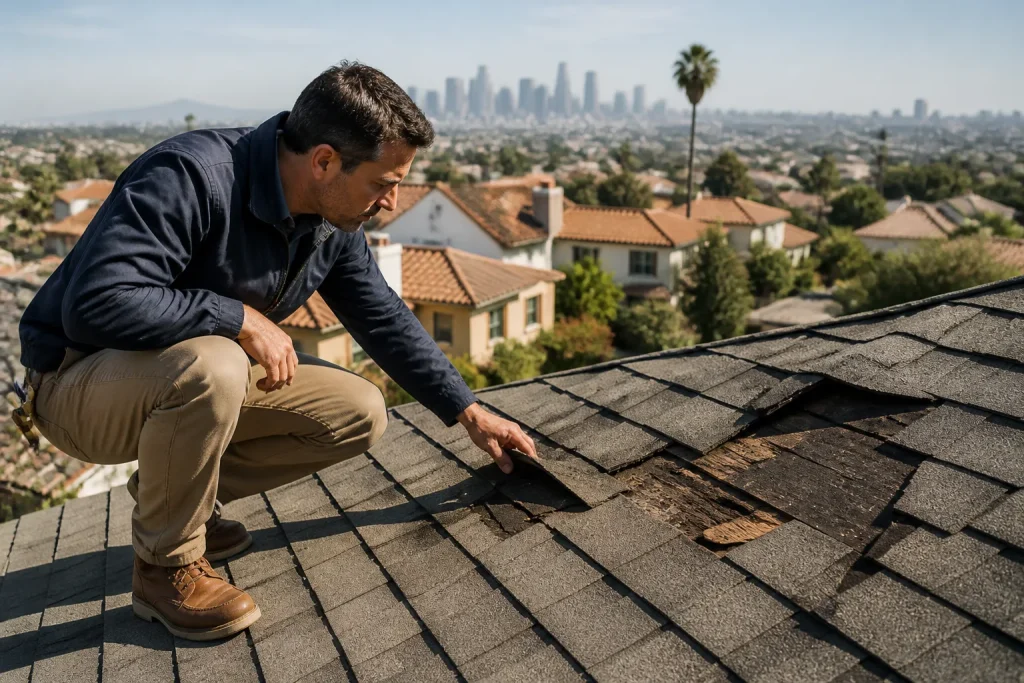
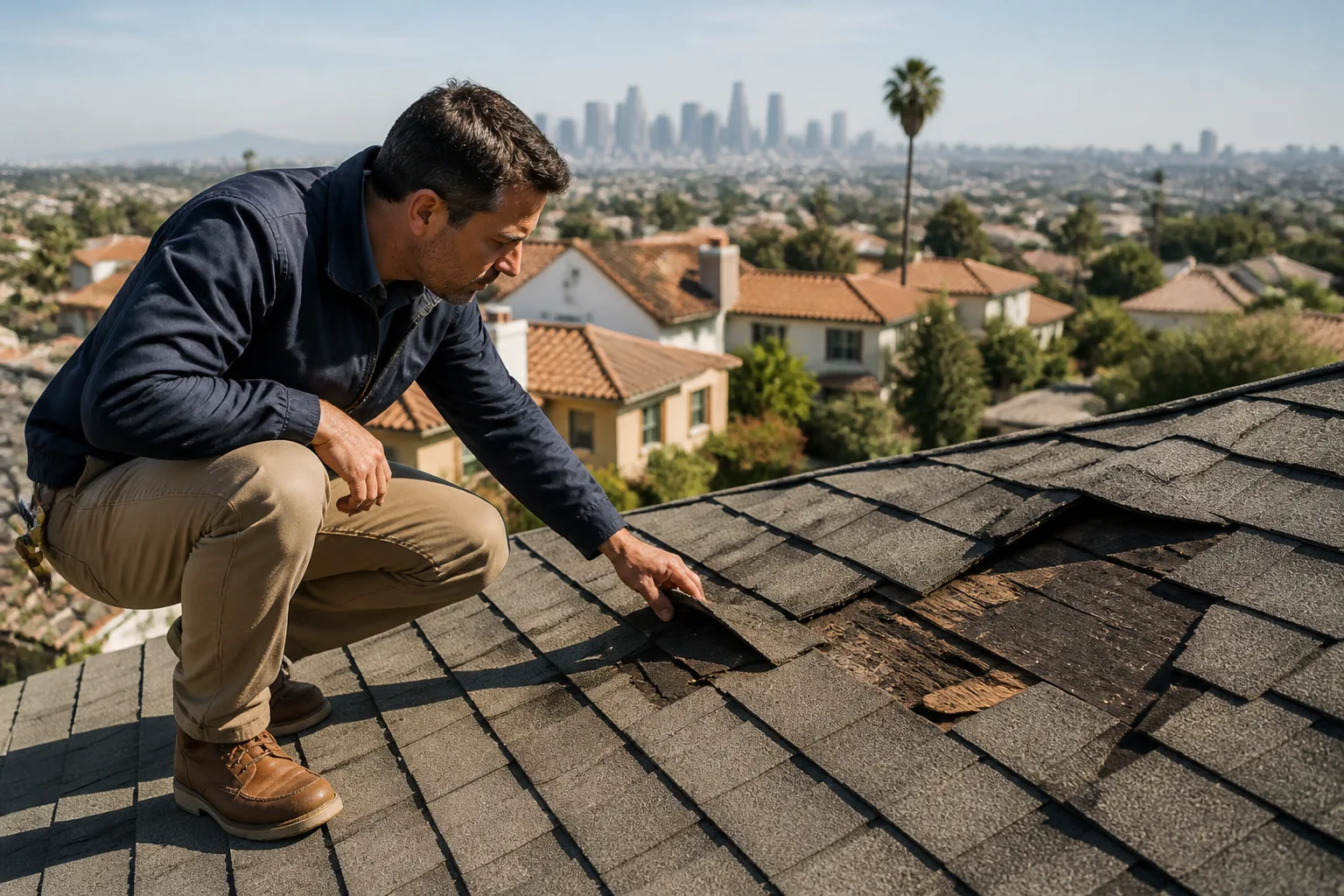
Decking is the structural layer, usually plywood or OSB, that the shingles are nailed into. It’s the roof’s skeleton. When decking starts to fail, the shingles above it can look completely fine. That’s what makes this the most underestimated factor in the repair-or-replace decision for Los Angeles homeowners.
A roof professional evaluates decking condition three ways. First, soft spots. We walk the roof and feel for deflection underfoot, which indicates moisture has compromised the wood. Second, delamination. Plywood layers separating, or OSB swelling at the edges, means water has been sitting where it shouldn’t. Third, improper nailing patterns. If the original installers missed the rafters or used the wrong fastener schedule, shingles can lift in wind events, and Santa Ana winds in Los Angeles will find every weak nail.
Here’s what this means for the decision:
- Repair makes sense when decking is dry, solid, and properly fastened, and the damage is isolated to a small area.
- Replacement makes sense when soft spots or delamination appear in multiple areas, because replacing sections of decking piecemeal often costs more per square foot than doing it as part of a full replacement.
- The honest answer is sometimes “inspect first.” You can’t know which category you’re in until someone gets on the roof and checks. Any roofer who quotes a repair without walking the roof and checking decking condition is guessing.
We’ve seen homes in the hills above Studio City where the shingles looked like they had five years left, but the decking under the north slope was spongy from years of debris sitting against the eaves. That roof needed replacement, not because the shingles failed, but because the structure under them had.
The Flashing System Is the Real Decision Point
Flashing is the metal, typically galvanized steel, aluminum, or copper, that seals the joints where the roof meets something else. Chimneys, skylights, vents, pipes, valleys, and wall intersections all rely on flashing to keep water out. Shingles shed water. Flashing manages water at the transitions. When flashing fails, water gets in even if every shingle is intact.
In Los Angeles, we see a lot of roofs where the shingles have years left but the flashing is done. Here’s why that pushes toward replacement:
- Flashing ages on its own schedule. Metal corrodes, sealant dries and cracks, and thermal expansion in the Los Angeles sun works joints loose over time. A 15-year-old roof can have flashing that’s effectively end-of-life even if the shingles look fine.
- Every penetration is a failure point. A typical Los Angeles home has six to twelve penetrations: plumbing vents, furnace flues, attic vents, skylights, and more. Replacing flashing at every one of those, plus valleys and wall intersections, adds up fast.
- Partial flashing replacement is a band-aid. You can re-flash one chimney and stop that leak. But if the flashing at the other penetrations is the same age and in the same condition, you’re scheduling future problems one at a time, and each one carries its own service call, its own repair cost, and its own risk of missed damage until water shows up inside.
The practical rule we use: if the flashing system needs work at more than three or four points, a replacement starts making financial sense, because you’re paying for the labor of accessing the roof repeatedly anyway. At that point, the cost-per-year math favors doing it once, correctly, with new flashing throughout.
Los Angeles Factors That Push the Replacement Threshold Earlier
Roof lifespan estimates you see online are national averages. They don’t account for what Los Angeles specifically does to a roof. Three local factors compress the practical lifespan and push the repair-or-replace decision toward replacement sooner than a homeowner might expect.
Santa Ana wind uplift. Santa Anas don’t just knock things over. They create sustained negative pressure on the leeward side of roof slopes, pulling shingles upward and stressing the nail points. Over years, this loosens the mechanical bond between shingles and decking. A roof that would last 25 years in a calm climate can start losing shingles in its early teens in wind-exposed parts of Los Angeles. If you’re finding shingles in the yard after every wind event, that’s not a repair problem. That’s a roof telling you the fastener system is failing.
Flat-pitch drainage issues. Los Angeles has a lot of low-slope and flat-roof sections, especially on mid-century homes and additions. Low pitch means water moves slowly, sits longer, and finds its way into any imperfection. Repairing isolated leaks on a flat or low-slope roof is notoriously unpredictable because water can travel far from the entry point before showing up inside. When a low-slope roof starts leaking in multiple places, replacement becomes the more predictable option.
Hillside debris loading. Homes in the canyons and foothills collect leaves, branches, and dirt from surrounding trees and slopes. Debris sitting on a roof holds moisture against shingles, blocks drainage, and accelerates decking rot. We’ve inspected roofs in neighborhoods like Mount Washington and Laurel Canyon where half the problem was simply that debris had been sitting on the roof for years. The shingles under those debris piles were compromised, but so was the decking beneath them.
None of these factors shows up in a generic roof lifespan chart. They show up when someone who works in Los Angeles walks your specific roof.
How to Compare a Repair Estimate and a Replacement Estimate Honestly
Most homeowners compare sticker price, and that leads to the wrong decision. The fair comparison is cost per year of expected service life. A $3,200 repair that buys you four years costs $800 per year. A $14,000 replacement that buys you 20 years costs $700 per year. The replacement is cheaper, just not at the moment you write the check.
Here’s the process we recommend to every homeowner facing this decision:
- Get both estimates in writing. Ask a roofer for a repair quote and a replacement quote, both itemized. If they won’t put both on paper, they’re not giving you enough information to decide.
- Ask what the repair covers, specifically. Not just “fix the leak.” Which flashing points? How much decking will be replaced? What’s the expected service life of the repair? The answer to that last question is the number you need.
- Ask what the replacement includes. Underlayment type, decking replacement allowance, flashing replacement at all penetrations, drip edge, and ventilation. A low replacement bid that excludes decking replacement or reuses old flashing isn’t a real replacement quote. It’s a repair dressed up as a replacement.
- Divide both numbers by their expected years. That’s your honest comparison.
One more thing on this: a written price should be a fixed price. At Brennan Roofing, the price goes on paper before any work starts, and it does not move at the door. If a roofer gives you an estimate and then starts adding change orders once the tear-off begins, that’s not an estimate, that’s a negotiation tactic. In Los Angeles, where roof decking conditions are highly variable house to house, the honest approach is to inspect the decking before quoting, not after.
The Substrate Inspection Every Repair Should Start With
Before any repair recommendation, a proper inspection has to look at what’s under the surface. Here’s what that inspection covers, how long it takes, and why skipping it is a red flag.
What it covers: The inspector walks the roof and checks for soft spots and deflection in the decking. They examine the underside from the attic, where visible, for water staining, mold, and delamination. They check every flashing point: chimneys, skylights, vents, valleys, and wall intersections. They look at the drip edge and the underlayment condition where accessible. In Los Angeles, they also check for debris accumulation, especially on hillside homes and under overhanging trees.
How long it takes: A thorough inspection on a typical Los Angeles home takes 45 minutes to an hour. If someone is on the roof for ten minutes and hands you a repair quote, they didn’t inspect the substrate. They looked at the shingles.
Why it matters: A repair is only as good as the surface it’s attached to. We’ve repaired roofs where we opened up one section and found decking that was structurally gone, the plywood crumbling in our hands. You can’t nail a repair to that. The homeowner had been told by another roofer that a “simple patch” would do it. It wouldn’t have, and it didn’t for the previous roofer either.
If you’re in Los Angeles and a roofer quotes a repair without walking the attic or checking decking condition, get a second opinion. The inspection is the difference between a repair that holds and a repair that buys you a year and a false sense of security. Brennan Roofing offers Roof Inspection in Los Angeles as a standalone service, with a written report on exactly what we found and what we’d recommend.
When to Call a Pro
Roof repair is not a DIY project, and in some cases it’s genuinely dangerous. Walking a roof without proper fall protection, or working on a steep pitch, or poking at decking that may be structurally compromised are all ways to get badly hurt. Even the inspection itself requires knowing where to step and what pressure a failing deck can take. If you suspect decking damage, or if you have a leak that’s persisted through one repair already, call a professional. The cost of the inspection is nothing compared to the cost of a missed diagnosis. For roof work specifically, Roof Repair in Los Angeles is what we do most often, and it always starts with the inspection.
The Bottom Line
The repair-or-replace decision in Los Angeles is really a decking-and-flashing decision. Sound decking and isolated flashing failure? Repair. Compromised decking or flashing that’s failed at multiple points? Replace, even if the shingles look fine. Los Angeles conditions, Santa Ana wind, low-pitch drainage, hillside debris, compress roof life and make the stakes higher than national averages suggest. Compare repair and replacement estimates on a cost-per-year basis, not sticker price. And never accept a repair recommendation that didn’t start with a real inspection of what’s under the surface. If you’re in Los Angeles and need help deciding, Brennan Roofing offers free estimates, including both repair and replacement options in writing. Call (361) 607-0835 and we’ll send a background-checked, uniformed technician who will walk the roof, inspect the decking, and give you an honest answer on paper before any work starts. The same standard we’d want on our own roof. That’s The Garrison Standard, and it’s the only way we work. Learn more about Brennan Roofing home and how we operate, or see our full Roofing Company in Los Angeles page for service details.
Frequently Asked Questions
Minor roof repairs in Los Angeles typically run between $350 and $1,200, while more involved repairs that include flashing replacement or small decking sections can range from $1,500 to $4,000. The exact number depends on what the inspection finds. Call (361) 607-0835 for a free estimate with the price in writing before any work starts.
Full roof replacement in Los Angeles generally ranges from $11,000 to $22,000 for a typical single-family home, depending on square footage, pitch, decking condition, and material choice from manufacturers like GAF, CertainTeed, and Owens Corning. The biggest variable is decking replacement, which can’t be known until tear-off. Call (361) 607-0835 for an exact quote, estimates are free.
Not with Brennan Roofing. The price goes on paper before any work begins, and it does not move at the door. If inspection reveals decking that must be replaced, that’s included in the written quote we gave you, not added as a surprise change order later. Every job is backed by the Done Right Promise: if it’s not done right, we make it right, in writing, at no charge for a full year.
Most roof repairs are completed in one day. A full replacement typically takes two to five days depending on roof size, pitch, and decking work required. Los Angeles weather rarely causes delays, but Santa Ana wind events can pause work for safety. Call (361) 607-0835 and we’ll give you a schedule commitment in writing along with the price.
Written by the team at Brennan Roofing.
Need Roofing Help?
Call Brennan Roofing - licensed & insured, here with fast after-hours help in Los Angeles.
(361) 607-0835