
5 Mistakes to Avoid With Roof Repair
Most roof repair mistakes happen before a single shingle is lifted. They happen in the conversation, in the paperwork, and in the panic after a storm. The five errors below are the ones we see turn a $400 repair into a $12,000 replacement in Los Angeles, and every one of them is preventable. If you’d rather not spend your weekend on a ladder, call (361) 607-0835 and we’ll send someone who can spot these problems from forty feet away.
Here’s the uncomfortable truth we’ve learned doing roof repair in Los Angelesa tarped-over roof can legally sit exposed for up to 90 days before a city inspector flags it. That means a contractor who says “we’ll tarp it now and schedule the repair later” has three months of runway to deprioritize your job while your decking soaks up water. The mistake isn’t the tarp. It’s believing the tarp is a plan.
Key Takeaways
- A verbal scope of work is worth exactly what you paid for it: nothing. Get line items on paper before any work begins.
- Moisture readings matter. Patching over wet decking guarantees the leak returns within a year.
- A material warranty is not the same as a workmanship guarantee. One covers the shingle. The other covers the hand that installed it.
- Roofs over 20 years old need a full condition assessment before you spend repair money, not after.
Mistake 1: Approving a Verbal Scope of Work
The most expensive sentence in roofing is “don’t worry, we’ll take care of it.” A verbal agreement on scope is the single most common way Los Angeles homeowners end up paying for the same repair twice. Here’s how it plays out: the leak is over the kitchen. The roofer says he’ll “fix the flashing and reseal the area.” He does something up there for two hours, you pay cash or a card, and six weeks later the same water stain spreads across the same ceiling corner. You call him back. He says that’s a different problem now, and it’ll be another $600.
A written, line-itemized scope protects you because it names exactly what gets fixed, what gets replaced, and what the roofer believes is causing the water entry. When you have that document, “the leak came back” triggers accountability. Without it, you have a memory against a memory. At Brennan Roofing home, the price goes on paper before any work starts. The scope says which roof slope, which flashing point, which underlayment section, and how many linear feet of replacement material. Not a range. Not an estimate. A line item with a dollar figure. That’s the only document worth signing.
If a roofer won’t put the scope on paper, that is not a negotiation. That’s an answer. Walk away.
Mistake 2: Patching Over Active Moisture Without a Reading
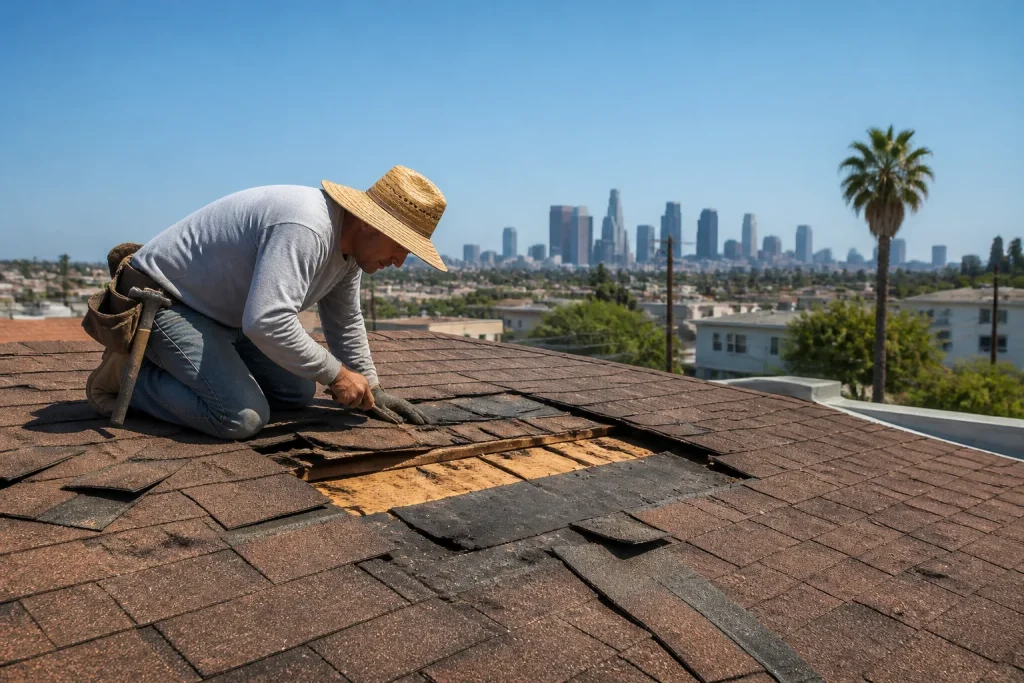
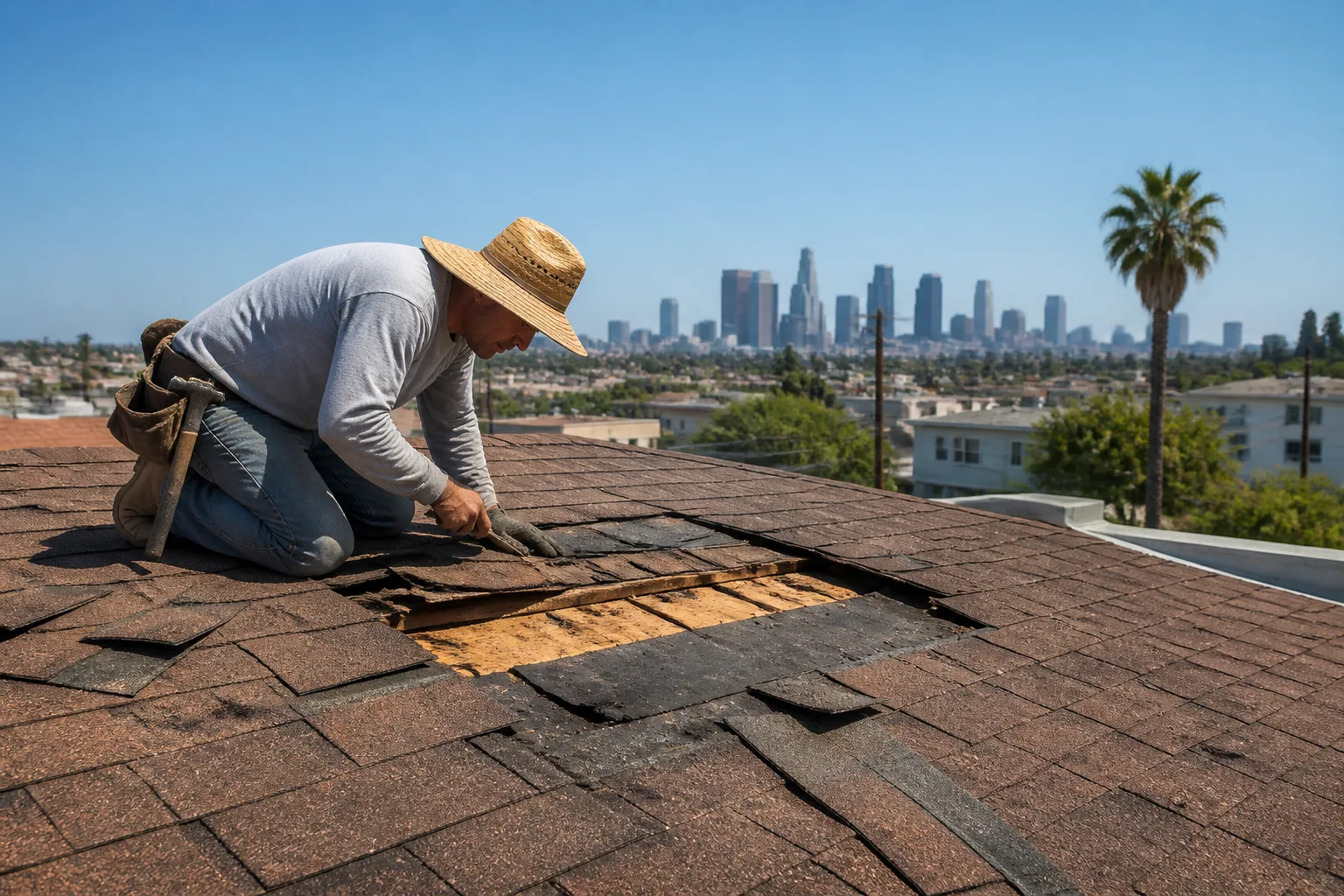
Water moves through a roof assembly in ways that surprise even experienced crews. A leak shows up at the interior ceiling, but the entry point can be eight feet away, running along the decking before it drips down. If a repair crew replaces shingles and underlayment over decking that is still holding moisture, the repair fails from the inside out. The moisture trapped beneath the new underlayment degrades the plywood, loosens the fasteners, and invites mold. The homeowner sees a dry ceiling for three months, then winter rains arrive and the stain is back.
In Los Angeles, this happens most often on flat and low-slope roofs in mid-century neighborhoods where decking sits under layers of built-up roofing. The only way to know if the decking is dry enough to close up is a moisture reading with a calibrated meter. A roofer should check the decking in the repair zone and the surrounding two to three feet. If the reading shows elevated moisture, the repair scope has to expand: remove the wet section, replace it, then install new underlayment and roofing. Yes, that costs more on the front end. It costs a lot less than reopening the roof again in April.
We pulled one out of a garage over in Silver Lake last year where a previous crew had patched a torch-down roof over decking that read 22 percent moisture on our meter. The homeowner had paid $850 for that patch eight months earlier. The fix required cutting out the wet decking, replacing it, and recovering the section. The original patcher never took a reading because he never owned a meter. Ask any roofer before they close up: “What does the decking read?” If they look at you blank, call someone else.
Mistake 3: Choosing a Contractor Based on Emergency Availability Alone
After a storm, every roofer in Los Angeles gets the same phone calls. Water is coming in, the tarp isn’t holding, and the homeowner wants someone on the roof today. That urgency is real. But it’s also exactly the condition under which vetting goes out the window and prices inflate. Contractors know that a homeowner with active water entry will say yes to almost any number. Demand spikes after every big rain event in LA. So do rates. And so do the number of unlicensed, uninsured, fly-by-night crews who suddenly appear in the neighborhood.
The mistake is not calling for help fast. The mistake is letting speed become the entire selection criteria. A roofer who can be on your roof in an hour is not automatically a good roofer. He might just be the one with no other jobs because nobody hires him twice. The disciplined move: get the tarp on, stop the active leak, and take a full day to check licensing, ask for references, read the scope document, and compare a written price. A legitimate roofing company in Los Angeles can usually inspect and tarp within a day or two even during storm season. A rush decision is exactly what the worst operators are counting on.
At Brennan Roofing, every technician who steps onto your roof is background-checked and arrives in uniform. That matters more during storm dumps than it does on a sunny Tuesday, because emergency work brings out the opportunists. The Garrison Standard exists for this exact moment: a written price before the work starts, not a handshake and a wink while water is dripping into the living room.
Mistake 4: Not Asking About a Workmanship Guarantee
Material warranties sound impressive because manufacturers like CertainTeed, Owens Corning, and Atlas stand behind their shingles. But a material warranty covers one thing: a defect in the product itself. If the shingle fails because it was manufactured wrong, the manufacturer pays for replacement material. That’s it. It does not cover the labor to remove and reinstall the shingle. And it certainly does not cover a leak caused by installer error, which is the cause of a significant share of repair callbacks in Los Angeles.
The warranty you need to ask about is the workmanship guarantee. This is the roofer’s written promise that the repair was done correctly. Most roofers don’t put that in writing because they don’t want to be held to it. The question to ask before you sign: “Does this repair include a workmanship guarantee, separate from the material warranty, in writing?” If the answer is a shrug and a phrase like “we stand behind our work,” that’s not a guarantee. That’s a slogan.
Brennan Roofing’s Done Right Promise is a written guarantee on every repair and installation for one full year. If the repair fails within that year, we come back and fix it at no charge. No prorating. No deductible. No debate about whose fault it is. That’s the difference between a guarantee and a warranty, and it’s the first thing you should ask for when a repair quote is in front of you.
Mistake 5: Treating a Repair as a Permanent Fix on an Old Roof
A repair on a roof that is over 20 years old is often a down payment on a replacement, not a solution. The math matters here. In Los Angeles, a typical asphalt shingle roof replacement on a single-family home runs between $12,000 and $22,000 depending on square footage, pitch, tear-off requirements, and material choice. A repair typically runs between $400 and $1,800. When the roof is two decades old and you’re putting $1,500 a year into chasing leaks on different slopes, you’re not maintaining the roof. You’re financing its decline in installments.
The smart move before spending significant repair money on an older roof is a full condition assessment. That’s not the same as a repair estimate. A repair estimate looks at the leaking area and tells you what it costs to fix that spot. A roof inspection in Los Angeles looks at the entire roof system: decking condition, underlayment state, flashing performance around penetrations and chimneys, drainage, and remaining shingle life. It answers the question you actually need answered: if I put $1,200 into this repair today, am I buying five more years or fifteen more months?
Sometimes the answer is that a repair absolutely makes sense. A single damaged flashing point on a 12-year-old roof is a repair. A roof where three different slopes are showing granule loss, two previous patched areas exist, and the decking is soft near the eaves is a different problem. That roof is telling you it’s done. Spending $4,000 over four years on piecemeal repairs before replacing it is the most expensive way to buy a roof. Get the condition assessment first, then decide.
When to Call a Pro
You should call a professional roofer whenever water is entering the house, when shingles are missing after a storm, or when you can see daylight through the decking from inside the attic. Ladder work on a two-story Los Angeles home with wet, moss-slicked shingles is not a weekend project. Roof falls kill more homeowners every year than you’d guess, and the slope that looks gentle from the ground gets a lot steeper when you’re standing on it with a bucket of mastic in one hand. If the repair involves flashing, underlayment, or any work near a skylight or chimney, call someone who does this every day.
Related services in Los Angeles: Roofing Company in Los Angeles for full replacements and new installations.
The Bottom Line
The roof repair mistakes that cost Los Angeles homeowners the most money are not skill errors on the roof. They are decision errors made before the work starts: approving a verbal scope, skipping a moisture reading, hiring in panic after a storm, accepting a material warranty as full protection, and pouring repair money into a roof that needed replacement three years ago. Each of those mistakes is preventable with one practice: slow down, get everything in writing, and make the contractor explain the roof to you before he touches it.
If you’re in Los Angeles and need help, Brennan Roofing offers free estimates. We’ll give you a written price before any work starts, and every repair is backed by the Done Right Promise. Call (361) 607-0835 to schedule yours.
Frequently Asked Questions
Most roof repairs in Los Angeles run between $400 and $1,800 depending on the repair type. A simple flashing fix or small shingle replacement is on the low end. Repairs that require cutting out wet decking, replacing underlayment, or working on flat built-up roofs run higher. You should always receive a written line-item price before work begins. Call (361) 607-0835 for an exact quote on your roof.
It should not, and at Brennan Roofing it doesn’t. The written price you receive before work starts is the price you pay. The only time a repair scope legitimately expands is when the crew opens the roof and finds an underlying condition the original inspection couldn’t see, like wet decking or rotted fascia. In that case, the additional work should be documented, priced, and approved by you before proceeding. Call (361) 607-0835 and we’ll walk you through how written pricing works.
Most standard roof repairs in Los Angeles are completed the same day the crew arrives, typically in two to four hours. Repairs that involve decking replacement, significant underlayment work, or flat roof recovery can take one to two days. Weather, roof accessibility, and the extent of hidden damage all affect the timeline. We’ll give you a realistic schedule with your written estimate. Call (361) 607-0835 to schedule an inspection.
It depends on the condition of the entire roof system, not just the leaking area. If the decking is solid, the flashing is intact, and only one isolated area is failing, a repair can extend the roof’s life by several years. If you’re seeing granule loss across multiple slopes, soft decking near the eaves, and repeated leaks in different locations, replacement is usually the better financial decision. A full condition assessment answers this definitively. Call (361) 607-0835 for a free estimate and honest recommendation.
Written by the team at Brennan Roofing.
Need Roofing Help?
Call Brennan Roofing - licensed & insured, here with fast after-hours help in Los Angeles.
(361) 607-0835