
Roof Inspection: Repair or Replace? How Los Angeles Homeowners Decide
Most Los Angeles homeowners don’t need a new roof. They need an honest read on the one they already have, and that read comes down to three numbers: how many years of service remain on the existing roof, what the repair actually costs as a percentage of full replacement, and whether the damage is isolated or spread across the whole system. If you’d rather skip the homework and get a straight answer, call (361) 607-0835 for a free inspection. Otherwise, here’s the framework we use when a homeowner asks us the only question that matters: fix it, or tear it off?
The “50 percent rule” gets thrown around a lot. If repairs exceed 50 percent of replacement cost, replace the roof. It sounds disciplined, and it’s easy to remember. But it ignores the variable that changes everything: remaining service life. A 10-year-old composition shingle roof in Los Angeles with 15 good years left can justify a $6,000 repair that’s 40 percent of a $15,000 replacement. The same $6,000 repair on a 22-year-old roof with three years left is a bad bet. Same repair percentage. Completely different answer. That’s the gap between a salesman’s recommendation and a real decision, and it’s the gap this post closes.
Key Takeaways
- The repair-or-replace decision runs on three variables: remaining service life, repair cost as a percentage of replacement, and whether the damage is isolated or systemic.
- In Los Angeles, a legitimate inspection means more than a surface walkover. Flat roof membranes, tile underlayment, ridge cap mortar, and attic ventilation all need eyes on them.
- Inspection report language matters. “Recommended,” “required,” and “monitor” mean three very different things for your timeline.
- Insurance adjusters after Santa Ana wind events routinely undercount damage. Document everything yourself before the adjuster shows up.
- The free estimate is the whole point. Written price before work starts, no number moves at the door.
The Three-Variable Framework: What Actually Decides Repair vs. Replace
When you strip away the sales talk, every repair-or-replace decision in Los Angeles reduces to three questions. Answer them in order, and the decision usually makes itself.
First, how many years of service remain? This is the number most homeowners never get, because most contractors won’t say it. But it’s knowable. A 25-year architectural shingle installed 8 years ago has roughly 17 years left, assuming standard Los Angeles sun exposure and decent attic ventilation. A flat roof with a modified bitumen membrane installed 12 years ago might have 3 to 5 years left given the UV load that Los Angeles flat roofs take. Tile roofs are different again: the tile itself lasts 50 to 75 years, but the underlayment beneath it typically fails at the 25 to 30 year mark, and that’s the part that actually keeps water out. Get the remaining-life estimate first. Without it, no other number on the page means anything.
Second, what does the repair cost as a percentage of replacement? In the Los Angeles market right now, a full tear-off and re-roof on a standard 1,600 square foot home runs roughly $12,000 to $20,000 depending on material, pitch, and decking condition. That’s your denominator. Now take your repair quote. A flashing repair might run $400 to $900. A localized valley repair might run $800 to $1,800. A partial re-deck around a plumbing vent with new underlayment might hit $1,500 to $3,000. A full re-deck plus new membrane on a flat roof section could run $4,000 to $8,000. Now do the math. If the repair is 10 percent of replacement and you have 10 years left, repair. If the repair is 45 percent of replacement and you have 3 years left, replace. The framework works every time because it refuses to let either number dominate alone.
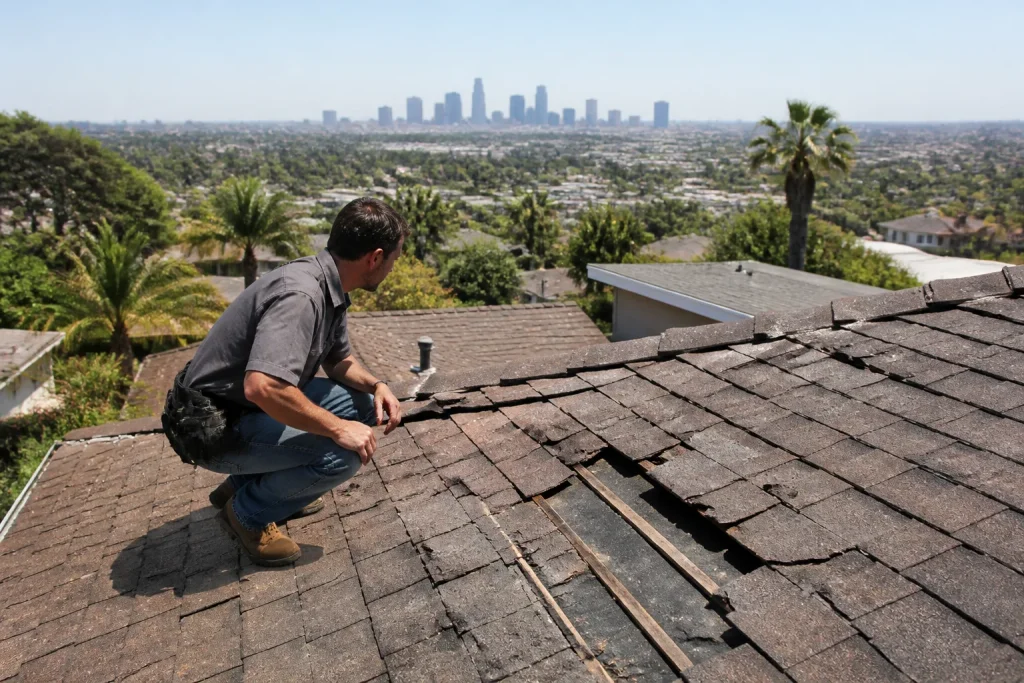
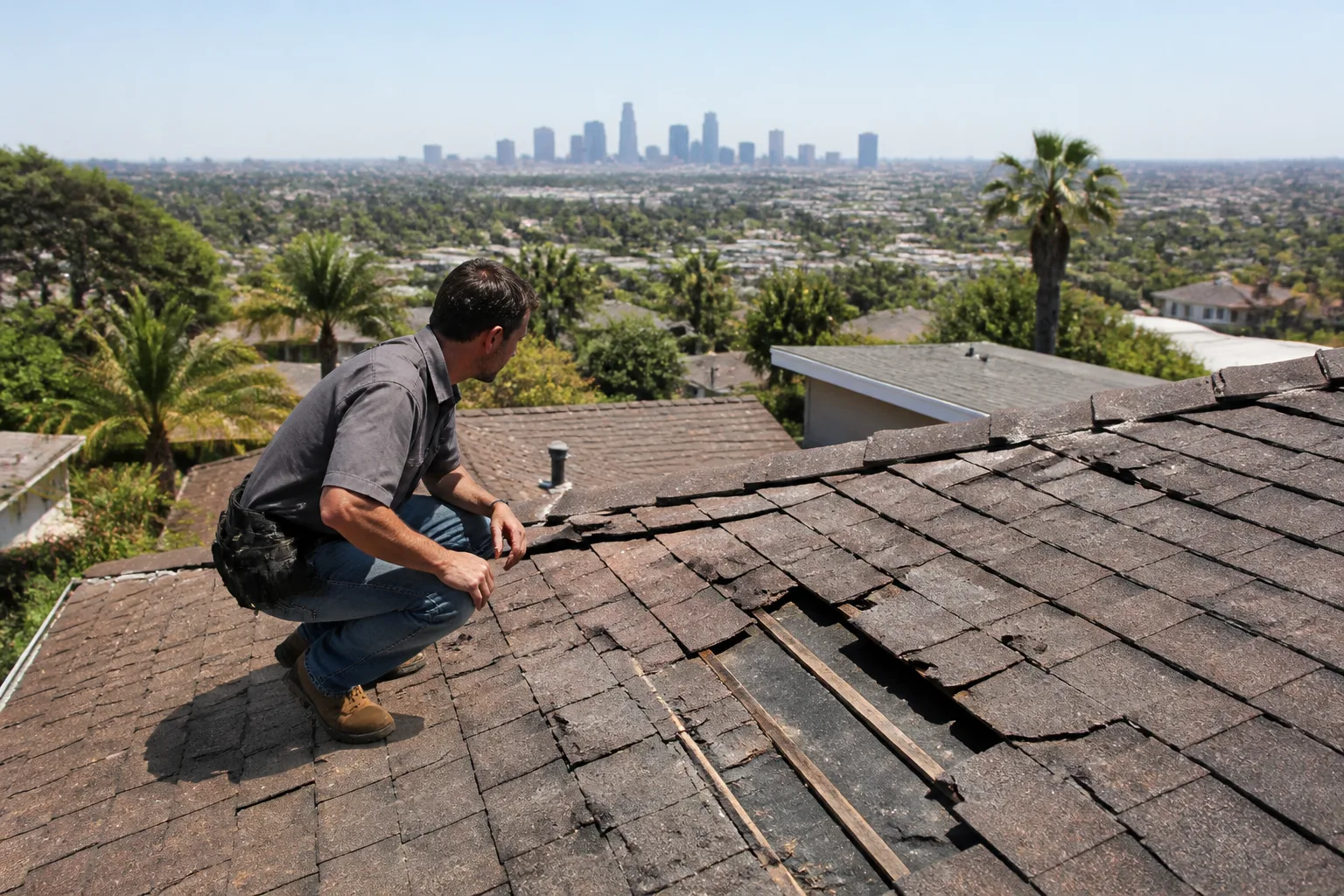
Third, is the damage isolated or systemic? One failed valley flashing is isolated. Widespread granule loss across the entire south-facing slope is systemic. Lifted shingles along one eave after a Santa Ana event is isolated. Curling shingles across every plane is systemic. Isolated damage on a roof with good remaining life almost always points to repair. Systemic damage means the material itself is aging out, and repairs become a game of whack-a-mole that costs more in five years than replacement would have cost on day one.
We tell Los Angeles homeowners to write these three answers down before calling any contractor. It puts you in the conversation as an equal, not a mark.
What a Legitimate Roof Inspection Covers in Los Angeles
A real roof inspection in Los Angeles is not a guy with a drone and a 20-minute schedule. The city’s housing stock includes four distinct roof types with four distinct failure modes: composition shingle, flat and low-slope membrane, concrete and clay tile, and Spanish mission tile. Each one needs specific inspection points, and if your inspector isn’t checking them, you’re paying for a walkover, not an inspection.
On a flat roof, the membrane is everything. We check for blisters, alligatoring, and seam separation. Los Angeles flat roofs fail at seams and transitions first, because that’s where thermal movement concentrates. We also check the condition of any standing water after rain, because ponding water on a flat roof shortens membrane life by years, not months. If your flat roof holds water for more than 48 hours after a storm, that’s a real finding, and it should be in the report.
On a tile roof, the tile itself rarely fails. The underlayment beneath it does. We look for cracked or slipped tiles as an entry point for water, but the real question is what the felt underneath looks like at eaves, valleys, and penetrations. That requires lifting tiles in a few strategic spots. A tile roof inspection that never lifts a tile is not an inspection.
On a composition shingle roof, we check for granule loss, nail pops, and sealant strip failures. Los Angeles’s intense UV exposure ages shingles faster on south and west exposures than on north slopes, and a good inspector notes the differential. If one slope is aging visibly faster than the others, that tells you something about ventilation, and that’s a fixable problem before it becomes a replacement problem.
And on every roof, we check ridge cap mortar and attic ventilation. Cracked mortar at the ridge lets water track sideways under the tile and rot the battens. Poor attic ventilation cooks the roof from underneath, cutting shingle life by 20 to 30 percent. In Los Angeles, an attic that hits 140 degrees in August is aging your roof twice as fast as a properly vented attic at 110 degrees. If your inspector never goes into the attic, the inspection is incomplete.
For more on what a full inspection looks like, see our Roof Inspection in Los Angeles page.
How to Read an Inspection Report: ‘Recommended,’ ‘Required,’ and ‘Monitor’
Inspection reports use three words that sound similar but mean very different things. Knowing the difference is the difference between spending $12,000 too soon and waiting $8,000 too long.
“Required” means the condition is actively causing damage or will cause damage within the current rainy season. Active leaks, exposed decking, failed flashing at a penetration, missing tiles over living space. Required items have a timeline measured in weeks, not months. In Los Angeles, a “required” item on a flat roof means you need it addressed before the next atmospheric river, because flat roof failures are not gradual. They’re sudden.
“Recommended” means the condition is deteriorating and will become required within 1 to 3 years. Cracked ridge cap mortar, granule loss on a single slope, sealant failures at HVAC curbs. Recommended items give you a planning window. You can budget for them, schedule them in the dry season, and avoid paying emergency rates.
“Monitor” means the condition is normal for the roof’s age and you should check it again at the next inspection cycle. Minor mineral staining, slight granule settlement, cosmetic flashing discoloration. Monitor items are not a call to action. A legitimate inspector will tell you that. A contractor looking for work will try to turn every “monitor” into a “recommended” and every “recommended” into a “required.”
The tell is whether the contractor can point to a specific failure mechanism. If they say “this flashing might leak,” ask where the water will enter, what it will hit, and how they know. If they can’t answer those three questions, get a second opinion. In our experience, the Los Angeles homeowners who get taken are the ones who never ask.
What Repairs Actually Cost in Los Angeles Right Now
You can’t make a repair-or-replace decision without real numbers, and contractors in Los Angeles count on you not having them. Here are the ranges we see across the city, from the Valley to the Westside to the South Bay. These are ballpark ranges for standard homes in Los Angeles, not quotes, but they’ll let you gut-check anything a contractor puts in front of you.
- Flashing repair (chimney, valley, or pipe boot): $400 to $900. This is the most common repair in Los Angeles, and it’s usually isolated. If flashing repair is the finding, repair almost always wins.
- Localized tile replacement (10 to 20 tiles, underlayment intact): $500 to $1,200. Tile matching matters, and Los Angeles has dozens of discontinued tile profiles. A good roofer sources the closest match and tells you upfront it won’t be exact.
- Valley repair with new underlayment: $800 to $1,800. Valleys concentrate water and fail first. But a valley repair on a roof with 15 years left is money well spent.
- Partial re-deck around a penetration with new membrane: $1,500 to $3,000. This is the fix when water has rotted the decking around a pipe boot or HVAC curb. Isolated, but more invasive.
- Full re-deck plus new membrane on a flat roof section: $4,000 to $8,000. This is the one that triggers the replacement conversation, because at this price you’re close to the replacement threshold on a small roof section.
Compare these against a full replacement of $12,000 to $20,000 for a standard Los Angeles home, and the repair-or-replace math gets much clearer. A $700 flashing repair on a 10-year-old roof is 4 percent of replacement, and it’s an obvious repair. A $6,000 flat roof re-deck on a 15-year-old membrane is 35 to 40 percent of replacement, and that’s a conversation about how many years that membrane has left.
One thing to know about the Los Angeles market specifically: demand for roofing surges after the first heavy rain of the season, and prices move with it. Contractors who quoted $600 for a flashing repair in August quote $900 in December. If your inspection finds a “recommended” item in July, scheduling the work before November is how you pay closer to August prices. That’s not scarcity marketing. That’s how the trades work in this city.
When Insurance Is Involved: The Santa Ana Problem
Santa Ana wind events cause a specific type of roof damage in Los Angeles: lifted shingles, blown-off tiles, and impacted flashing along windward roof edges. And insurance-driven inspections after those events have a well-documented tendency to undercount the damage, because adjusters are trained to look for visible surface damage, not the subtle failures that show up six months later.
Here’s what we tell Los Angeles homeowners before the adjuster arrives. Document everything yourself. Take photos of every roof plane in the morning light when shadows show lifted shingles clearly. Photograph the ground around your home for fallen granules, which indicate shingle loss even when the shingles look intact from the ground. Walk the perimeter and photograph any asphalt, tile, or membrane debris. If you can safely access the attic, photograph the underside of the decking for water staining, especially near penetrations and along the ridge.
Then get an independent inspection from a contractor who works for you, not for the insurance company. A wind event that lifts 40 shingles on the windward edge also weakens the sealant strips on the adjacent 200 shingles, and a good inspector will note that. It’s not fraud. It’s a more complete description of the damage event. We’ve walked into Los Angeles homes where the adjuster found 12 lifted shingles and our inspection found 60 structurally compromised ones, and the difference was a $4,000 claim being paid instead of a $900 one.
One more thing: in Los Angeles, wind-driven debris often damages tile underlayment without breaking a single tile. The tile looks fine from the ground, but the felt underneath is torn at the eave. If you see moisture stains in the attic after a Santa Ana event and no broken tiles, you need someone to lift tiles and check the underlayment. Don’t let the adjuster tell you there’s no damage because the tile looks fine.
The Roof Repair in Los Angeles page covers what wind damage repair looks like in practice, and the Brennan Roofing home page explains how we price the work before it starts.
When to Call a Pro
You can make the repair-or-replace decision yourself once you have the three variables in front of you. You cannot safely do the inspection that produces those variables. Roof inspection involves walking on surfaces that can be steep, brittle, or degraded, and falls from Los Angeles roofs injure more homeowners every year than storms do. If the roof is steep enough that you’re questioning your footing, you already have your answer. Call us.
There’s also the liability angle. Walking a tile roof without knowing which tiles will bear weight will crack tiles, and cracked tiles are a new problem you created. Walking a flat roof membrane with the wrong shoes will puncture it. We wear the right shoes, we know where to step, and we carry the insurance if something goes wrong. You don’t need to be on that roof. You need the information that comes from someone who should be.
The Bottom Line
The repair-or-replace decision in Los Angeles is not about the 50 percent rule. It’s about remaining service life, repair cost as a percentage of replacement, and whether the damage is isolated or systemic. Get those three numbers from a legitimate inspection, read the report language for what it actually says, and the decision usually makes itself. The homeowners who get burned are the ones who skip the framework and listen to whichever contractor talks loudest.
Brennan Roofing operates under The Garrison Standard: written price before any work starts, background-checked uniformed technicians, and a Done Right Promise in writing on every job. If a repair fails within the guarantee period, we come back for free. No change orders at the door. No pressure. If you’re in Los Angeles and want a straight answer on whether to repair or replace, call (361) 607-0835 for a free estimate. The Roofing Company in Los Angeles page has more on how we work.
Frequently Asked Questions
A standard roof inspection in Los Angeles typically costs between $200 and $500, though many contractors, including Brennan Roofing, offer free inspections with a written report when the roof has suspected damage. Free inspections tied to a sales pitch are common in this market, so ask upfront whether the written report is yours to keep regardless of whether you hire the inspector.
Composition shingle roofs in Los Angeles last 18 to 25 years depending on sun exposure and attic ventilation. Flat roof membranes last 12 to 20 years. Tile underlayment lasts 25 to 30 years even though the tile itself lasts much longer. The Los Angeles climate accelerates aging on south and west exposures, so two slopes on the same roof can be at very different stages of life.
Yes, and in most cases repair is the right call. A localized flashing repair, valley repair, or partial re-deck on a roof with 10 or more years of remaining life is usually 10 percent of the cost of replacement and buys you years of service. The decision comes down to whether the damage is isolated and whether the remaining life justifies the repair cost.
Insurance typically covers wind-related roof damage, but adjusters often undercount the full extent of it. Document everything with photos before the adjuster arrives, including lifted shingles, granule accumulation, and attic staining. An independent inspection from a contractor who works for you, not the insurance company, is the best way to make sure the claim covers the real damage. Call (361) 607-0835 and we’ll walk the roof with you before the adjuster shows up.
Written by the team at Brennan Roofing.
Need Roofing Help?
Call Brennan Roofing - licensed & insured, here with fast after-hours help in Los Angeles.
(361) 607-0835