
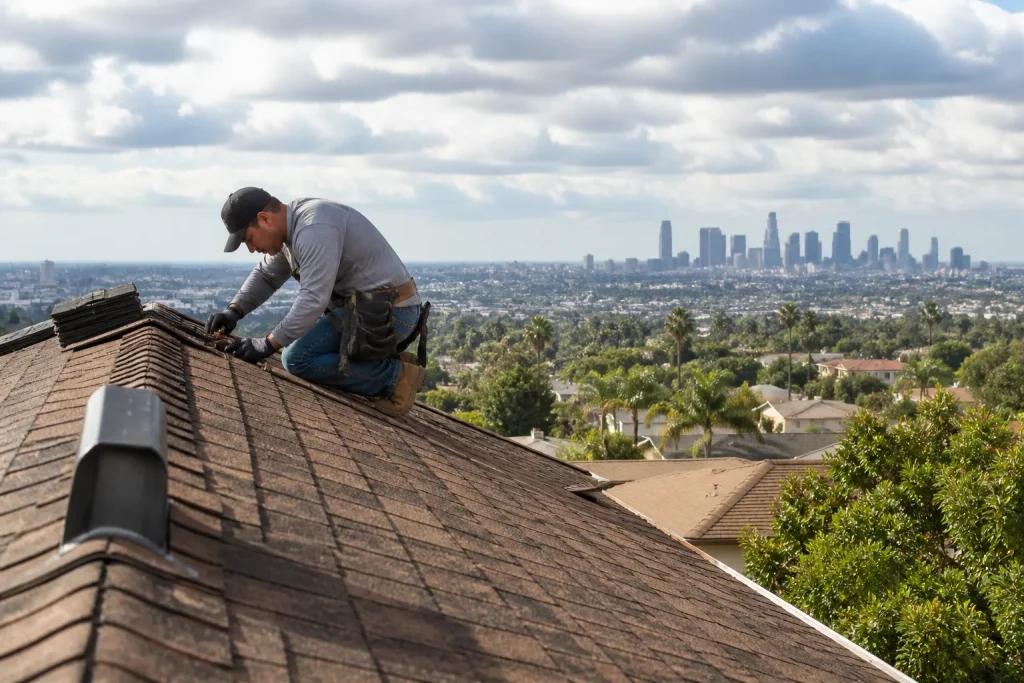
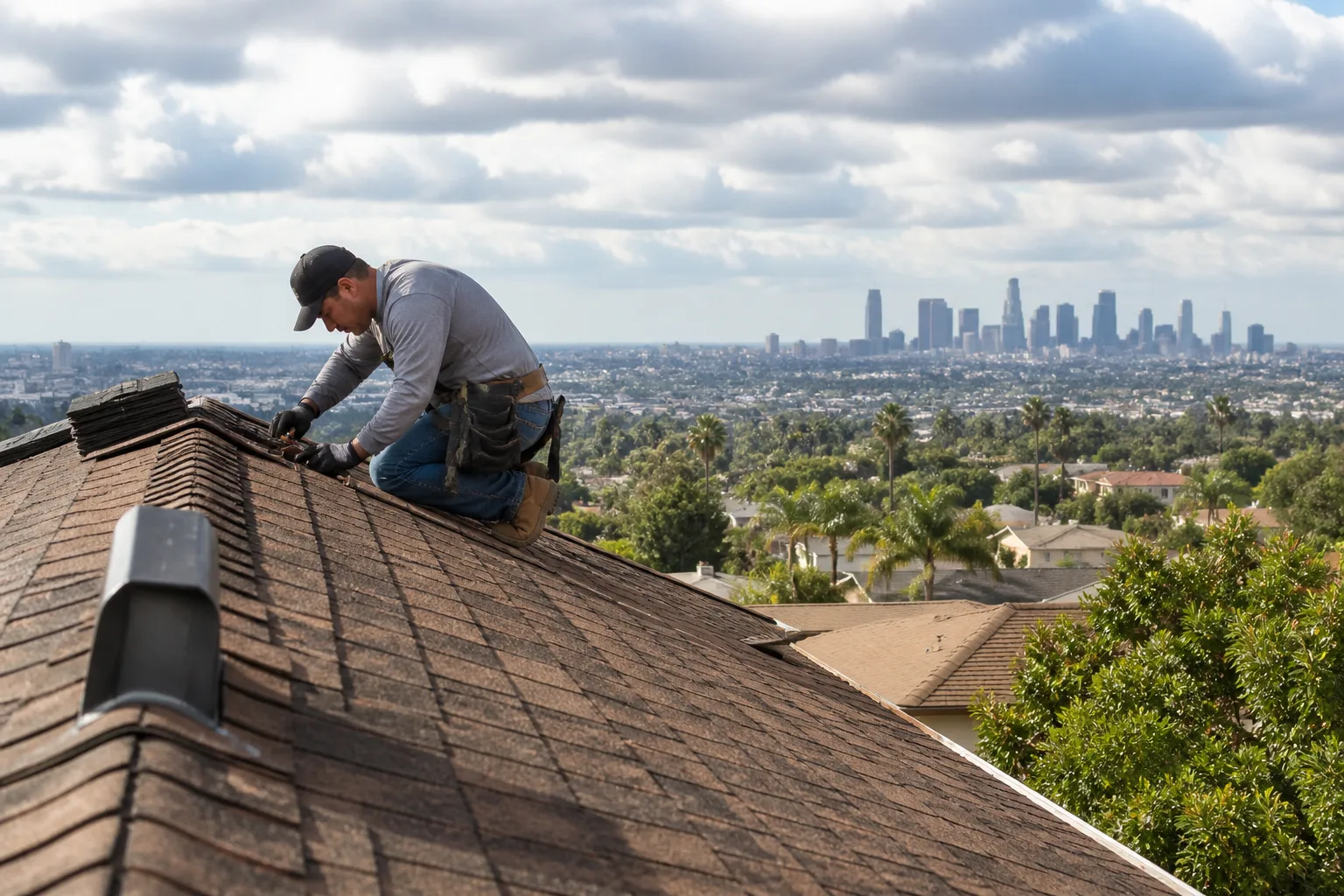
Preparing Your Home’s Roofing for Winter in Los Angeles
Preparing your roof for winter in Los Angeles means clearing debris from valleys and gutters, re-sealing dried-out flashing caulk and pipe boots, checking pan flashing at chimneys, trimming back overhanging vegetation, and photographing everything so you can prove storm damage if a January deluge finds a weak spot. Most LA homes need this work done between late September and early November, after the heat breaks but before the first real rain. If you’d rather not get on the roof yourself, call (361) 607-0835 and we’ll handle the whole checklist.
Los Angeles averages only 14 inches of rain per year, but roughly 80 percent of that falls between November and March. That means your roof absorbs nearly a full year’s worth of water stress in five months, and it lands on flashings and caulk that have been baking and shrinking in the sun since the previous winter. This is the unique problem LA homeowners face: not ice dams or snow load, but a long dry season that quietly opens gaps, followed by sudden concentrated rain that finds every one of them.
Why LA’s Dry-Wet Cycle Is Harder on Your Roof Than a Wet Climate
In a consistently wet climate, roof materials stay saturated and expand predictably. In Los Angeles, the cycle is more violent. From May through October, temperatures routinely climb into the 80s and 90s, and roof surfaces hit 140 to 160 degrees. Flashing caulk, roofing cement, and rubber pipe boots bake in that heat. They dry out, lose flexibility, and pull away from the surfaces they’re supposed to seal. Then November rain arrives, and water follows the cracks.
We’ve seen this play out on thousands of LA roofs. A pipe boot that looked fine in August gets brittle by October. A bead of caulk around a chimney flashing that was watertight last winter has shrunk by an eighth of an inch, and an eighth of an inch is all water needs. In wetter climates, materials don’t get the same oven treatment between rain events, so the deterioration is slower and more predictable. LA homeowners can’t assume last year’s seal is still good. They need to check it before the rain does.
The same expansion and contraction affects flashing metal. Long runs of galvanized or aluminum flashing heat up, expand, cool down, contract. Over enough seasons, the fasteners loosen and the laps open slightly. It’s not dramatic. There’s no visible hole. But a lap that’s opened a sixteenth of an inch across a 10-foot run is a channel for water.
If you’re anywhere in Los Angeles with a roof more than 8 years old, this cycle has already begun working on your flashing. The question isn’t whether it’s happening. It’s whether you catch it before January.
The Five Inspection Points That Predict Winter Leaks in LA
We’ve condensed our pre-winter roof inspection into five specific checkpoints that, in our experience, account for the large majority of winter roof leaks in Los Angeles homes. This is exactly where our Roof Inspection in Los Angeles work starts.
1. Pan flashing at chimneys. The pan is the flat piece of metal that sits behind the chimney and redirects water around it. Over time, the caulk where the pan meets the brick or stucco dries and separates. In North Hollywood and Sherman Oaks, where older masonry chimneys are common, this is our number one leak source every winter. Re-caulking a chimney pan typically costs $150 to $350 in Los Angeles.
2. Valley metal condition. Valleys are the angles where two roof planes meet, and they carry more water than any other part of the roof during a storm. Look for exposed nail heads, rust, or gaps in the metal. If the valley has been patched with roofing cement over the years, and that patch is cracking, it’s time to replace the metal run. Valley metal replacement in LA usually runs $400 to $900 depending on length and pitch.
3. Pipe boot seals. The rubber collar around plumbing vent pipes degrades from sun exposure, and when it cracks, water drips straight down the pipe into your ceiling. A new pipe boot and collar costs $40 to $80 in materials, and a roofer will usually install it in under an hour. It’s the cheapest high-impact fix on the entire pre-winter checklist.
4. Flat-to-pitched transitions. Many LA homes, especially mid-century builds in the Valley and parts of the Westside, have flat low-slope sections meeting pitched shingle sections. The transition flashing where they meet is a chronic weak point. If the membrane on the flat section is old or the transition metal is lifting, water pools and finds the seam. Spot repairs here typically range from $300 to $700.
5. Gutter-to-fascia gaps. In LA’s dry months, gutters fill with dust, leaves from jacarandas, and fine debris that bakes into a crust. When rain comes, water backs up under the roof edge if gutters are clogged or gaps have opened between gutter and fascia. Clearing gutters before the first rain prevents backup, and re-securing loose gutter runs prevents fascia rot. Gutter clearing on a single-story LA home runs $150 to $300.
If any of these five points shows damage, the fix is much cheaper in October than it is in December, after water has been running through it for a month. Click over to Roof Repair in Los Angeles if you need a fuller picture of what our repair work covers.
Key Takeaways for Pre-Winter Roof Prep in Los Angeles
- Do the work between late September and early November, before the first heavy rain arrives.
- Inspect the five failure points: chimney pan flashing, valley metal, pipe boot seals, flat-to-pitched transitions, and gutter-to-fascia gaps.
- Budget $150 to $350 for chimney re-caulking, $400 to $900 for valley metal replacement, $150 to $300 for gutter clearing.
- Photograph every area before and after you fix it. If January brings storm damage, those photos support your insurance claim.
- Don’t skip the small stuff. Cracks in caulk and brittle pipe boots cause more LA winter leaks than missing shingles.
Roof-Adjacent Vegetation: What to Cut Back Before the First Rain in Los Angeles
Overhanging branches do two things to California roofs. They drop debris that traps moisture against shingles, and they physically brush the surface in the wind, wearing away shingle granules over time. On the bungalows and ranch homes that make up so much of Los Angeles, this is especially noticeable along the eaves, where tree branches hang against the roof line.
Jacarandas, eucalyptus, and ficus are the worst offenders in LA. Jacaranda drops fine leaves and litter that packs into valleys and gutters. Eucalyptus drops long leaves that mat together and hold water against the shingle surface for weeks. Ficus has aggressive root systems that can heave roof drains on flat sections, and its fine seed pods clog downspouts quickly. If any of these trees overhang your roof, cut the branches back at least 6 feet from the roofline before the rains start.
Granule loss is the quiet cost. Shingles are coated with ceramic granules that block UV radiation and provide fire resistance. When branches scrape the surface in wind, they knock those granules loose. The bare asphalt underneath ages faster, and in a city where wildfire season now overlaps with rainy season, a shingle that has lost its granules is more vulnerable to firebrand ignition from a neighbor’s chimney or a nearby brush event. Keeping vegetation off the roof is a cheap, boring insurance policy.
If your roof line is high or the branches are substantial, don’t attempt this yourself. A fall from an extension ladder while holding a pruning saw is a life-changing injury. Hire a licensed tree trimmer or, if the branches have already committed to heavy contact with the roof surface, call us and we’ll assess whether the shingles have already sustained damage. The Brennan Roofing home page has more on how we approach those assessments.
What Pre-Winter Roof Maintenance Actually Costs in Los Angeles
You should not have to call a roofing company just to get a ballpark number. Here are realistic ranges for the pre-winter maintenance items we’ve covered, based on what we see across Los Angeles, from the South Bay up through the Valley:
- Chimney pan re-caulking and re-seating: $150 to $350
- Pipe boot replacement: $100 to $200 installed
- Gutter clearing and downspout flush: $150 to $300 for a single-story home, $250 to $500 for a two-story
- Valley metal replacement: $400 to $900 depending on run length and roof pitch
- Flat-to-pitched transition re-seal: $300 to $700
- Debris removal from roof surface and valleys: $100 to $250 as part of a maintenance visit
These numbers assume standard composite shingle roofs on single-family homes. If your roof is tile, concrete, or a flat membrane system, the numbers move. The point is that a full pre-winter maintenance pass on a typical LA home usually lands between $400 and $1,200, and it’s almost always cheaper than the drywall, insulation, and framing repair that follows a winter leak.
Every job we do at Brennan Roofing starts with a written price before any work begins. That’s not a preference. It’s the Garrison Standard, and it applies to every update, repair, or inspection we write. The number on the paper does not move at the door. If you call Roofing Company in Los Angeles page, you can see the full scope of what we do and how we price it.
Documenting Your Roof’s Pre-Winter Condition for Insurance Claims
If a January storm rips shingles off your roof in Los Angeles, your insurance company is going to ask a question: was this damage caused by the storm, or was it wear and tear that the storm happened to expose? The difference matters. Wear and tear is a maintenance issue, and most policies don’t cover it. Event-caused damage is a covered loss. Your photos are the evidence.
Take these photos in late September or early October, every year:
- Full-roof shots from at least two angles, standing back far enough to see the entire roof plane.
- Close-ups of each flashing detail: chimney, valleys, pipe boots, transitions, and roof penetrations like skylights or solar mounts.
- Gutter runs and downspout outlets, showing they are clean and properly secured.
- Any area where vegetation touches or nears the roof surface.
- The underside of the roof deck in the attic, focusing on the driest, most exposed sections.
Store these photos somewhere you’ll actually find them in February. A folder on your phone, an email to yourself, a cloud drive. When your adjuster asks what the roof looked like before the storm, you’ll have dated proof that the flashings were sealed, the valley metal was sound, and the pipe boots were intact. A homeowner who can show a pre-storm photo set is in a much stronger position than one who says, “I think it was fine before the rain.”
This is also why we document everything during a pre-winter Roof Inspection in Los Angeles. We photograph the details, we note the condition, and we give you a written record. If the storm comes and something fails, you know it wasn’t an existing issue we ignored. That’s the Garrison Code: the condition of the roof goes in writing, and the record follows the homeowner.
When to Call a Pro Instead of Doing It Yourself
Most of the inspection and photography work on this list is safe for a homeowner with a good ladder and a healthy respect for heights. But there are lines that shouldn’t be crossed. If your roof pitch is steeper than a 6-in-12, if it’s a two-story home with no safe ladder tie-off, or if the inspection means walking on tile, call someone who does it for a living. Tile is brittle and expensive, and every step on a tile roof risks cracking pieces you can’t always see.
We pulled a pack of broken Mission tiles out of a roof over in Atwater Village a few years back, and the homeowner had been walking the ridge to clear leaves every fall for a decade. He’d cracked enough tiles over the years that the underlayment had started rotting underneath them, and the winter leak he was trying to prevent was already underway. The repair cost more than ten years of professional inspections. That one stuck with me.
If you can’t commit to the full checklist, we can. We’re a Roofing Company in Los Angeles that sends background-checked, uniformed technicians on every call. You know exactly who is on your roof. We answer the phone with a live person, 24/7. And every inspection or repair comes with a written price in hand before we start, plus the 365-Day Done Right Promise in writing: if it’s not done right, we make it right at no charge for a full year.
The Bottom Line
Los Angeles winters don’t test your roof with snow and ice. They test it with sudden heavy rain after months of dry heat, and the heat has already done the damage by the time the rain arrives. Check the five failure points, clear your gutters, trim the vegetation, document everything with photos, and you’ll be as ready as any LA home can be. Skip it, and the first real storm of the season will tell you exactly where your deferred maintenance was hiding.
If you’re in Los Angeles and want help with the pre-winter checklist, Brennan Roofing offers free estimates. Call (361) 607-0835 and we’ll get you on the schedule before the first rain.
Frequently Asked Questions
Inspect and re-seal the five common failure points (chimney pan flashing, valley metal, pipe boot seals, flat-to-pitched transitions, and gutter-to-fascia gaps), clear all debris from valleys and gutters, trim back overhanging vegetation, and photograph the roof’s condition before the first storm. Do this between late September and early November. Call (361) 607-0835 if you’d rather have a professional handle it.
A full pre-winter maintenance pass on a typical LA single-family home usually runs between $400 and $1,200, depending on what needs attention. Individual items range from $150 to $350 for chimney re-caulking, $100 to $200 for pipe boot replacement, and $150 to $300 for gutter clearing. Every Brennan Roofing job comes with a written price before work starts, so you’ll know your exact number before anything happens.
Yes. LA receives about 80 percent of its annual rainfall between November and March, and the long dry summer has usually caused caulk and sealant to dry out and crack by then. Without pre-winter prep, those gaps become leak paths when the first heavy rain arrives. Snow is not the only winter threat; concentrated rainfall on a dried-out roof is the LA version of winter weather.
Yes. Dated photos of flashings, valleys, pipe boots, and gutter runs taken before the rainy season give you a strong evidence trail if a storm damages your roof later. Insurance adjusters need to distinguish event-caused damage from normal wear and tear, and a pre-storm photo set makes that case for you. Store the photos somewhere accessible so you can produce them in February without digging through old phones.
Written by Travis Oakley, Owner at Brennan Roofing, serving Los Angeles since 2000.
Need Roofing Help?
Call Brennan Roofing - licensed & insured, here with fast after-hours help in Los Angeles.
(361) 607-0835